Krea University
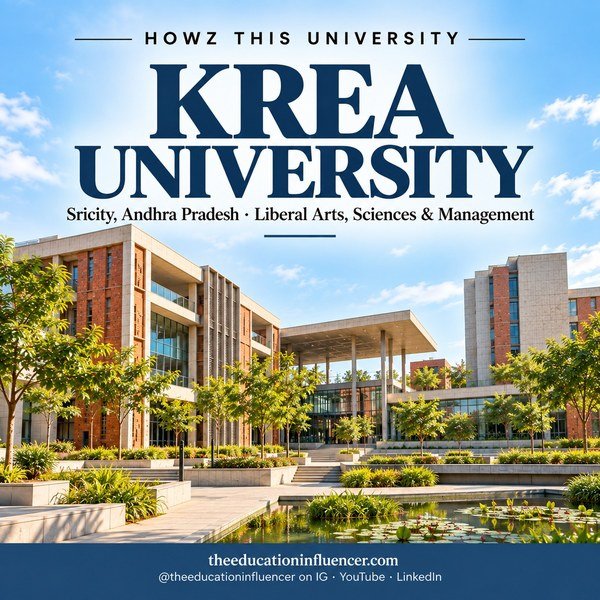
Most new-age universities start with a founder's dream and an empty plot of land. Krea University started differently: with a 49-year-old business school, a legacy relationship with ICICI's Narayanan Vaghul, and a deliberate decision to merge an established institution into something new rather than build entirely from scratch. Founded in 2018 in Sricity, Andhra Pradesh, Krea calls its approach "Interwoven Learning." So, howz this university?
The Snapshot
Quick Vitals: Krea University, Sricity
- Founded: 2018, sponsored by IFMR Society, a not-for-profit established in 1970 by a group including Narayanan Vaghul, former chairman of ICICI. Kapil Viswanathan, an entrepreneur who exited ed-tech company Lumina Datamatics in 2016, played the central role in conceiving and establishing the university
- Location: Sricity, Andhra Pradesh, roughly 70 km north of Chennai and 21 km from Sullurupeta railway station
- Type: State private university, sponsored by IFMR Society, approved by UGC
- Campus: 40 to 50 acres, fully residential (sources vary slightly on exact acreage)
- Structure: Two schools: the School of Interwoven Arts and Sciences (SIAS), offering undergraduate liberal arts and science degrees, and IFMR Graduate School of Business (IFMR GSB), offering MBA and integrated BBA+MBA programmes
- Accreditation: UGC approved; IFMR GSB re-accredited by the South Asian Quality Assurance System (SAQS) through June 2029
- NIRF 2024 Ranking: #99 in the Management category (for IFMR GSB specifically; SIAS does not appear in NIRF's undergraduate liberal arts category)
- QS Rating: QS 5-Star rating for Teaching and Employability (university-reported)
- UG Total Cost (SIAS): Roughly ₹28.5 lakh to ₹38.6 lakh for the four-year BA (Hons) or BSc (Hons), depending on specialisation (figures vary by source and year; confirm current numbers directly with the university)
- MBA Total Cost (IFMR GSB): Roughly ₹14 lakh to ₹18.7 lakh, with the five-year Integrated BBA+MBA around ₹31.9 lakh
One structural fact worth understanding before anything else: Krea is really two institutions sharing a campus and a brand. SIAS (undergraduate liberal arts) and IFMR GSB (the MBA school) have different admissions processes, different outcomes, and, as you'll see below, meaningfully different placement pictures. Treat them separately when you evaluate this university, not as one blended statistic.
What It Teaches
SIAS offers a four-year BA (Hons) or BSc (Hons), with the option to exit after three years with a plain BA or BSc. The curriculum spans 16 majors and 18 minors across Arts, Science, Business, Humanities, and Social Sciences, with over 500 possible subject combinations, and students are not required to declare a major at the point of admission. A distinctive feature is the Double Major option, letting students combine any two available majors rather than choosing one, an unusually broad degree of academic flexibility even by the standards of other liberal arts universities on this list.
Krea also runs ten research centres that students can engage with directly, working with international agencies, governments, and policymakers, alongside tailor-made annual internships, externships, and work-study programmes built into the degree structure rather than left to students to arrange independently. The university frames its academic philosophy as "Interwoven Learning," meaning students are expected to draw connections across disciplines deliberately, rather than treating each subject as a self-contained silo.
IFMR GSB, the separate business school, offers a two-year MBA, a five-year Integrated BBA+MBA, an Executive MBA, and customised executive education programmes, plus PhD tracks awarded through the University of Madras in fields including Organizational Behavior and Human Resource Management, Strategic Management, Finance, Information Systems and Data Science, Economics, Marketing, and Operations Management. This PhD breadth reflects IFMR's older, more established research history as a nearly-fifty-year-old institution before it became part of Krea, distinct from SIAS's much younger research footprint.
Getting In
For SIAS, students do not declare a major at the time of admission. The process includes an application review, followed by a Krea Admissions Assessment, and shortlisted candidates then go through a personal interview. Students may only apply in one round per admissions cycle; applying in multiple rounds in the same cycle results in disqualification, a stricter rule than several other liberal arts universities on this list, worth knowing before you plan your application timeline. For the 2026 cycle, Round 1 applications closed January 4, 2026.
Eligibility for SIAS is a Class 12 pass or equivalent from a recognised board, with no fixed subject-stream requirement, consistent with the liberal arts model. The university does not publish detailed letters-of-recommendation requirements as a hard rule across all rounds, according to its own admissions FAQ, so applicants should check the specific requirements for whichever round they're applying in rather than assuming a fixed format.
For IFMR GSB's MBA programmes, admission runs through standard management entrance exams (CAT, XAT, and similar), consistent with most Indian B-schools, rather than Krea's own separate assessment used for SIAS. This is a meaningfully different process from the undergraduate route, and it's worth being clear about which programme, and which admissions path, you're actually preparing for.
Life on Campus
The campus is fully residential, described consistently across independent student reviews as modern, green, and peaceful, with air-conditioned hostel rooms, a fitness studio, a student hub with indoor games, a unisex salon, a basketball court, and a futsal turf. The library holds more than 30,000 books.
Eighteen active clubs run at SIAS, covering Conversation, Dance, Fine Arts, Gaming, Innovation and Entrepreneurship, Literary Arts, and Media Arts, among others. Multiple student reviews describe the club and events culture as genuinely active, and several specifically praise the career services office for helping students land internships in their first and second years.
The trade-off shows up consistently too: several reviews independently flag that Sricity is removed from any city center, with "no outer market or places to hang out" nearby, and that the university, while improving, isn't yet as strong a name as a top metro university. That's a real, repeated observation from actual students, not a one-off complaint, and it's worth weighing seriously if being near a city matters to you.
Sricity itself is a planned industrial township, not a traditional college town, which explains both sides of what students report: a genuinely peaceful, purpose-built, green environment for studying, alongside a real lack of the informal off-campus life (cafes, markets, a walkable neighbourhood) that students at an urban campus would take for granted. Several reviews describe the food and hostel quality as strong relative to the fee level, which is worth weighing against the location trade-off rather than in isolation.
The Faculty
Krea describes its faculty as drawn from leading academic institutions worldwide, mixing early-career scholars with highly experienced academics, a mix the university frames as combining "path-breaking young scholars" with "highly experienced experts." Student reviews consistently rate faculty quality and accessibility highly, with several specifically noting that professors interact with students regularly rather than staying at a distance, a point that shows up repeatedly enough across independent reviews to be a genuine pattern rather than a one-off compliment.
On the graduate business school side, IFMR GSB draws on faculty affiliated with its long-running SAQS accreditation process, a five-year re-accreditation running through June 2029, which typically requires sustained faculty research output and industry engagement to maintain. Specific faculty-student ratio figures are not consistently published across independent sources for either school, so confirm directly with the university if this matters to your decision.
For a prospective student weighing Krea against an older, more established university, the honest comparison point is this: Krea's faculty pitch rests more on direct accessibility and teaching engagement than on decades of published research output or a long roster of widely recognised names, consistent with being a young institution still building its academic reputation.
Where Graduates Go
This is the section where treating SIAS and IFMR GSB separately matters most. All figures below are university reported via third-party aggregator coverage.
IFMR GSB (MBA): Placements have shown a clear upward trend. The MBA batch of 2023 recorded a highest package of ₹22.9 LPA and an average of ₹13.5 LPA, a 22% rise over the prior year. The 2024 season saw a highest package of ₹21.74 LPA with an average and median both around ₹13 LPA, across 70 participating companies with 23 pre-placement offers. NIRF 2024 data recorded 184 MBA students placed at a median salary of roughly ₹13.1 lakh. Recruiters across cycles have included JP Morgan, Deloitte, PwC, Wipro, HSBC, Axis Bank, Barclays, ICICI Bank, Cognizant, and Standard Chartered.
SIAS (undergraduate Arts and Science): The picture here is thinner and more mixed. One aggregator reports a highest package of ₹14.4 LPA and an average of ₹6.8 LPA for Arts and Science graduates, with recruiters including Nomura, Morgan Stanley, JP Morgan, Deloitte, KPMG, EY, and PwC. But at least one independent student review states plainly that SIAS does not currently guarantee placements the way BBA-style programmes do, though the reviewer noted the university intends to build this out further in coming years. If placement support is a deciding factor for your undergraduate choice specifically, this is worth confirming directly with the university before applying, not assuming from the MBA numbers.
The gap between these two pictures is the single most important thing to understand about Krea's outcomes. IFMR GSB's numbers reflect a business school with roughly five decades of institutional history and a well-worn placement process. SIAS's numbers reflect a liberal arts programme that graduated its first cohort only in 2022, still building that same infrastructure. Neither figure should be read as representing "Krea" as a single entity, they represent two different schools at two very different stages of maturity.
Alumni Worth Knowing
Krea is young enough (its first SIAS cohort graduated in 2022) that a long alumni track record doesn't yet exist the way it does at older institutions. What's documented: SIAS graduates have gone on to postgraduate study at institutions including the London School of Economics, SOAS University of London, Yale University, and the London School of Hygiene and Tropical Medicine, across fields spanning Economics, Curating Cultures, Environmental Management, and Public Health. This is early-stage evidence of strong higher-study outcomes rather than a long corporate alumni record, worth knowing as a genuinely different kind of proof point than an older university would offer.
The Startup Culture
One of Krea's eighteen SIAS clubs is dedicated specifically to Innovation and Entrepreneurship. Independent, detailed information on incubation infrastructure, funding support, or student-founded ventures was not found in this round of research; if this matters to your decision, it's worth asking the university directly for specifics rather than assuming a formal incubator exists.
What Makes It Different
Three things genuinely set Krea apart, based on the evidence rather than the marketing copy:
- It didn't start from zero. Krea absorbed a 49-year-old business school (IFMR) with an existing accreditation history and institutional relationships, rather than building an entirely new institution's credibility from scratch, a genuinely different founding path from most new-age universities on this list.
- No major declared at admission, across 500+ combinations. The scale of subject combination flexibility, 16 majors and 18 minors with a genuine Double Major option, is unusually broad even among liberal arts universities.
- Two distinct schools under one roof. Running an established graduate business school (IFMR GSB) alongside a new undergraduate liberal arts school (SIAS) is a structurally unusual combination, and it means Krea offers something close to two different university experiences depending on which programme you're evaluating.
What to Know Before You Choose
- SIAS placement support is still developing. Unlike IFMR GSB's well-established MBA placement process, at least one direct student account suggests SIAS placement support isn't yet guaranteed. Ask the university for current, programme-specific placement data before assuming the MBA numbers apply to your undergraduate degree.
- Location. Sricity is genuinely remote from any major city center, repeatedly flagged by students as limiting outside exposure and social options beyond campus.
- Brand recognition is still building. Multiple student reviews note directly that Krea "is not as strong as a top metro university yet" while also noting it's improving. Weigh this honestly against how much brand name matters for your specific goals.
- Cost. The SIAS undergraduate total cost (roughly ₹28 to 39 lakh) sits in a similar range to other new-age liberal arts universities on this list, not dramatically cheaper.
The Fit Test
This university is for you if:
- You want genuine subject flexibility and don't want to commit to a major before you arrive
- You're drawn to a quiet, close-knit, fully residential campus experience
- You're comfortable being an early cohort at a still-young institution and want to help shape what it becomes
- You're specifically interested in the MBA through IFMR GSB, where the placement track record is well established
Think carefully if:
- Guaranteed undergraduate placement support is a primary deciding factor for you right now
- You want to be near a major city for internships, exposure, or simply access to urban life
- Brand recognition with employers and family matters more to you than academic flexibility
- Krea University official website, krea.edu.in (about, admissions, SIAS programmes, IFMR GSB history) — accessed September 2026
- LEAD at Krea University, ifmrlead.org (founding history, IFMR Society background) — accessed September 2026
- EducationWorld, "Smooth launch of India's pioneer interwoven arts & sciences university" (founding account, Narayanan Vaghul) — accessed September 2026
- Wikipedia: Krea University, Srini Raju — accessed September 2026
- Krea University placement and fee data via CollegeDunia, Careers360, Shiksha, Zollege, and SelectYourUniversity aggregator reporting of official and NIRF figures — accessed September 2026
- Independent student reviews via Careers360 and Zollege — accessed September 2026
Placement and fee figures are compiled from third-party aggregator reporting of university-released and NIRF data, and are marked "university reported" throughout. SIAS and IFMR GSB outcomes are reported separately wherever source data allowed; where a source blended the two, that has been noted. Figures can change year to year; confirm current numbers directly with the university before making a decision.
Krea is a genuinely interesting case: an established, well-regarded business school (IFMR GSB) sharing a campus with a young, still-developing liberal arts school (SIAS). If you're looking at the MBA, the track record is real and the trajectory is upward. If you're looking at the undergraduate SIAS programme, you're placing real trust in an institution still building out its placement infrastructure, in exchange for an unusually flexible academic model and a peaceful, still-forming campus community.
The subject flexibility is real and rare. The placement guarantee, for undergraduates specifically, is not yet.
A strong pick if flexibility matters more to you than a settled track record.
Next issue: Howz This University? Plaksha University
← More HOWZ This University reviews